
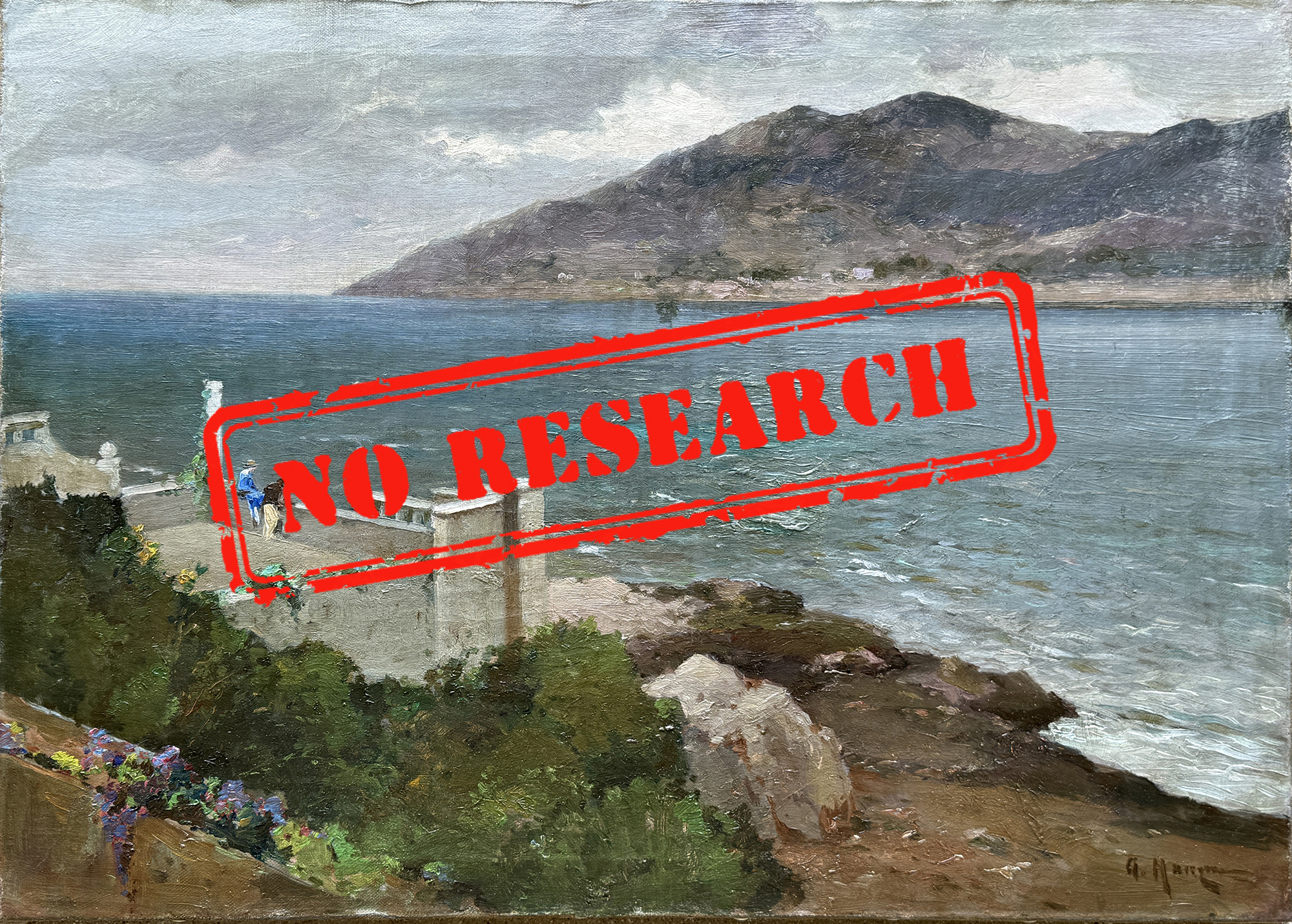
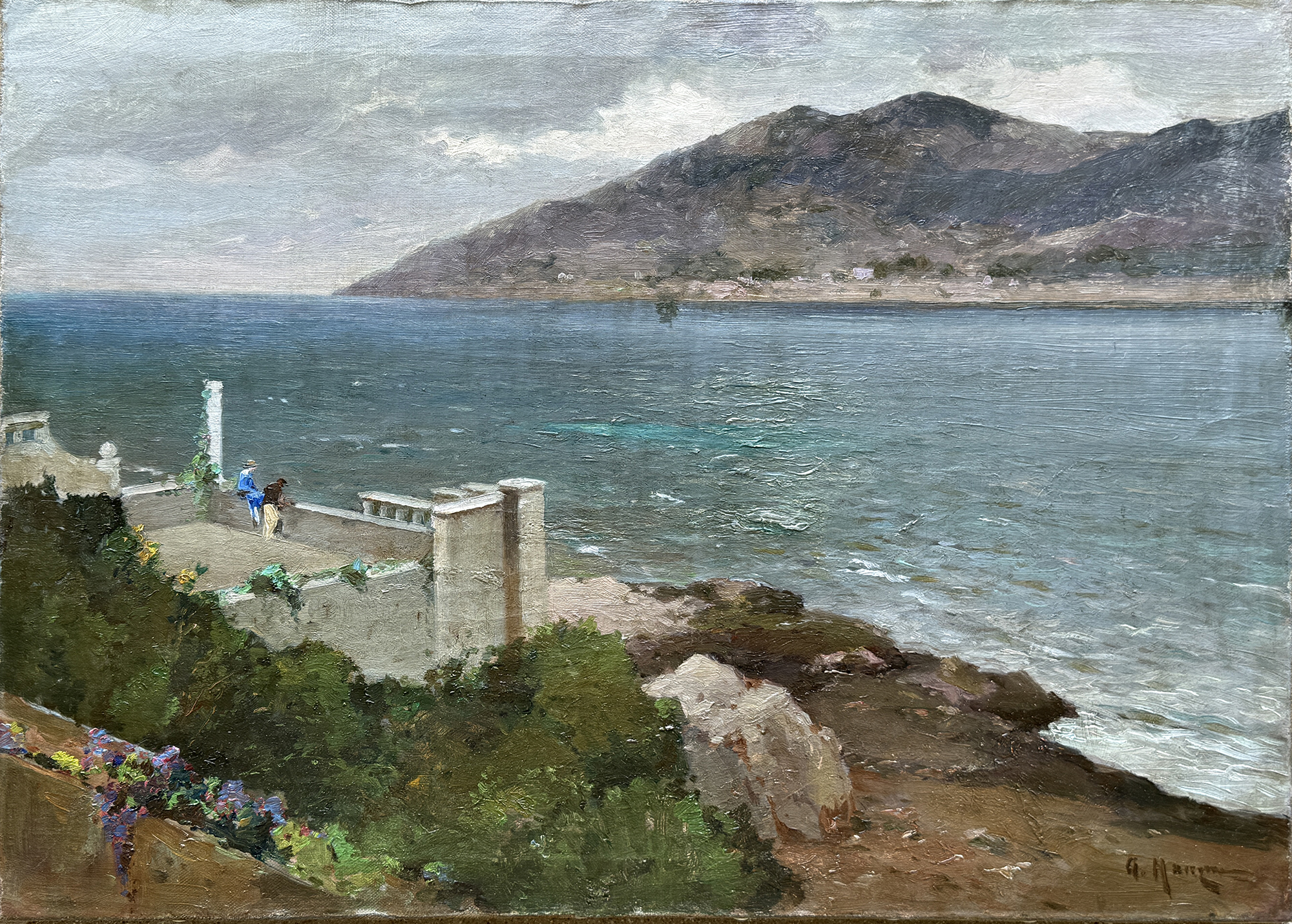
A client recently contacted DOCANTIC about a painting he had purchased several years ago at an auction in Los Angeles. He liked it. He had bought it because something about the painting caught his eye. But there was one minor problem: Nobody seemed to know what it was.
The auction house had not identified the artist. It had not identified the location. It had not identified the figures. And meaningful provenance?
Nope.
The label on the reverse represented approximately the full extent of the investigation: “Unframed coastal scene, signed lower right.”
That was it.
Case closed, apparently.
Except for one rather inconvenient little detail: The painting was signed.
Our client therefore came to DOCANTIC with a deceptively simple question: “Can you please find out what this painting actually is?”
Sure. Why not? So we opened the file.
Before beginning any serious investigation, DOCANTIC decided to try something terribly old-fashioned: We contacted the auction house that had sold the painting.
Crazy idea. Yeah, we know!
We politely asked whether they had any provenance, whether the consignor had provided information about previous ownership, or whether somewhere, perhaps buried in a drawer, forgotten in a file, or hiding under somebody's coffee cup, there might be anything telling us where the painting came from.
After all, the auction house had accepted the painting from somebody. They had catalogued it, photographed it, sold it, and, of course, collected their commission from both the buyer and the seller.
So we thought they might perhaps know something about it. Or, failing that, answer an email.
Nothing...Radio silence.
Not “Unfortunately, we have no additional information.” Not “The provenance is confidential.” Not even a miserable little “Thank you for your inquiry.”
Our email apparently entered the same black hole as the painting's provenance.
Gone.
So much for Plan A.
We were left with exactly what the buyer had received from this impressive exercise in scholarship: a painting, a perfectly visible signature, and the breathtakingly informative catalogue description: “Unframed coastal scene, signed lower right.” Sherlock Holmes could take the afternoon off.
Fortunately, at DOCANTIC, when a painting is signed, we have developed a rather revolutionary investigative technique: we try to find out who signed it.
We put every available brain at DOCANTIC on the case, called a few snitches, shook down a couple of well-connected friends, leaned on our contacts, slipped a few envelopes under the right doors and bribed a politician or two.
That last part was surprisingly easy...Then we waited.
A little digging here, a whisper there, a few doors kicked open, metaphorically, of course, and abracadabra... a name dropped: Alexei Vasilievich Hanzen (1876–1937).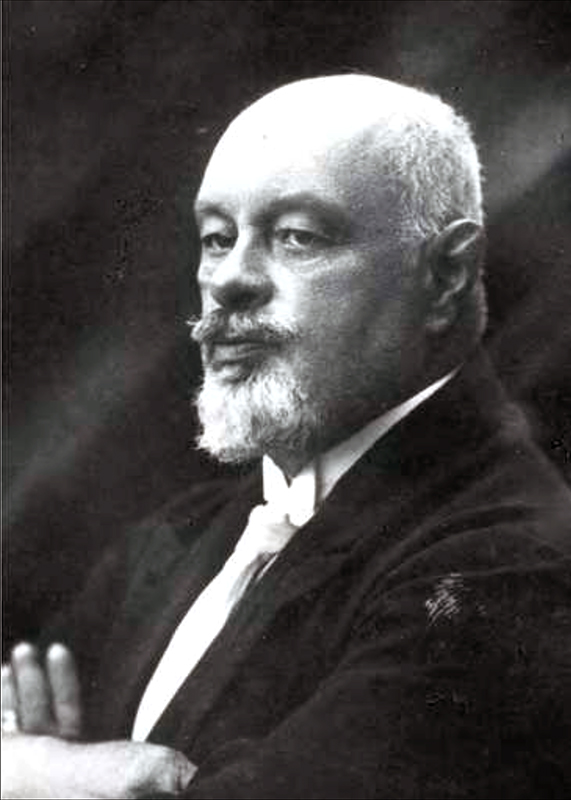
Well, well, well.
Our little anonymous “coastal view” was suddenly becoming considerably less anonymous.
Alexei Vasilievich Hanzen was a Russian marine painter and, more intriguingly, the grandson of Ivan Konstantinovich Aivazovsky, one of the greatest marine painters of the nineteenth century.
He grew up surrounded by an extraordinary artistic legacy but built a substantial career of his own, exhibiting internationally and producing an extensive body of marine paintings.
So, case closed? Not a chance.
Finding the artist only gave us another problem. We had a name. We had a sea. We had mountains. We had a terrace. But where the hell were we?
Back to the investigation.
A few more doors. A few more calls. No politicians this time, the budget was getting out of hand.
And eventually our trail led to Irina Kasatskaya, historian, researcher and great-granddaughter of Alexei Hanzen, who has devoted years to reconstructing and preserving the artist's oeuvre and her family's history.
We showed Irina the painting, she looked at it, and she knew. This wasn't some anonymous stretch of Mediterranean coastline. This wasn't simply an attractive coastal landscape. It was home.
Following the Russian Revolution, Alexei Hanzen and his wife, Olimpiada, succeeded, with great difficulty, in leaving Russia in January 1920.
In 1922, Hanzen purchased a villa on the Dalmatian coast in Dubrovnik and named it Villa Olympia, in honor of his wife.
From its terraces, the family looked across Gruž Bay. The villa, the bay and the surrounding Dubrovnik landscape became recurring subjects in Hanzen's paintings.
Irina recognized the view. She recognized the terrace. Historical photographs from her private family archive confirmed the remarkable correspondence between the architecture and landscape visible in the painting and Villa Olympia.
Among the photographs shared by Irina is this remarkable image of Alexei Hanzen himself, standing on the terrace of Villa Olympia and waving toward the camera. (Exhibit #2).
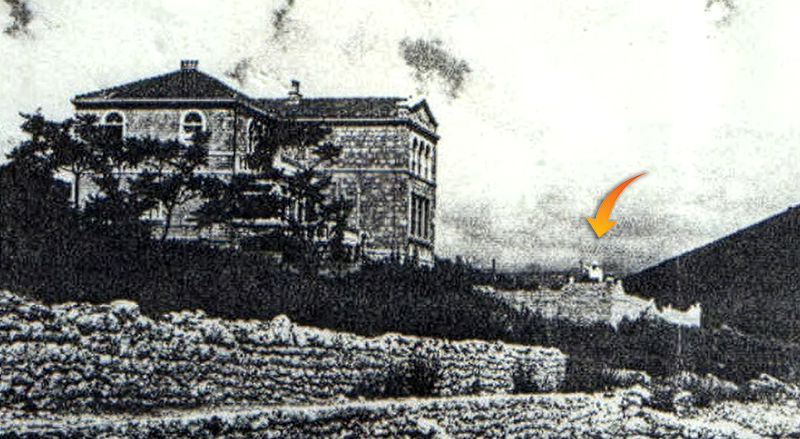
(Exhibit #2)
The anonymous “coastal view” had recovered its location. It was: View of Gruž Bay from Villa Olympia in Dubrovnik
But the investigation was about to become far more personal,
Because there were people on the terrace.
The figures are tiny. In ordinary photographs of the painting, they are extremely difficult to decipher. High-resolution images, however, revealed something that had initially escaped notice.
There were not two figures. There were three.
Okay. New problem.
A young woman wearing a light blue dress and hat sits sideways on the terrace wall. Beside her stands a man in a brown jacket and light-colored trousers. Close beside him is a young boy.
We sent the enlarged images to Irina. She and her daughter examined the group carefully. Same verdict: a woman, a man and a child.
Now we had three people on the terrace, and no names.
Fortunately, Irina had something considerably more useful than an auction-house catalogue: a family archive.
The woman is very plausibly Varvara Nikolaevna Muruzi. The child is very plausibly her son, Mikhail “Misha” Muruzi (1922–1933).
And then came an extraordinary piece of evidence.
Among the photographs preserved by Irina is a private black-and-white photograph showing Varvara seated sideways on the same terrace wall at Villa Olympia, with Olimpiada beside her. (Exhibit #3).
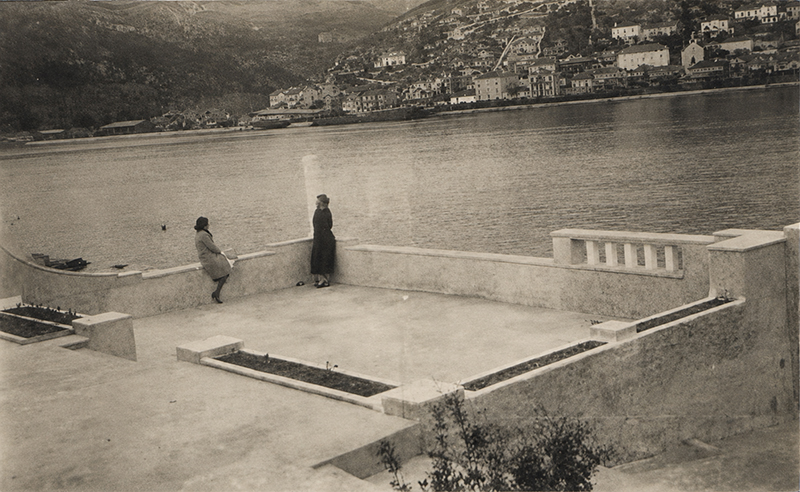
(Exhibit #3)
Almost a century later, photograph and painting suddenly confronted one another. The place was the same. The position was strikingly similar. The family connection was becoming impossible to ignore.
Two figures were beginning to have names.
But there was still the third...The man.
So who was our mystery man?
To understand the answer Irina would eventually propose, we first had to understand what this family had endured.
After the Revolution, only Alexei Hanzen and Olimpiada were able to leave Russia. Olimpiada's sons, Konstantin and Vladimir, remained behind and fought during the Civil War.
Konstantin was married to Varvara. Their son, Mikhail, known within the family as Misha, was born in Moscow in 1922. In 1925, Konstantin received permission to send his wife and young son by ship to Dubrovnik. So Varvara and Misha left.
Konstantin could not.
After their departure, Konstantin and his younger brother Vladimir attempted to cross the border themselves, hoping to reach Dubrovnik and reunite with their family. They were arrested.
Both brothers were sent to the Solovetsky Special Purpose Camp, where they remained for three years. In 1928, they were transferred to forced settlement in Barnaul, in the Altai region. Meanwhile, thousands of kilometers away, life continued at Villa Olympia.
But it was a life of waiting.
Varvara and Misha lived at Villa Olympia with Alexei and Olimpiada. Misha was deeply loved. Irina has told us that Alexei Hanzen was particularly attached to the boy and personally taught him foreign languages.
And all of them were waiting, waiting for Konstantin, waiting for Vladimir, waiting for the day when the family might finally be reunited in Dubrovnik. According to Irina, Varvara and Misha spent much time walking on the open terrace and sending photographs.
That detail would become crucial. Because after studying the three figures in the painting and reflecting upon the stories transmitted through her family, Irina proposed an interpretation that completely transformed our understanding of the work.
We now had two likely identities. Varvara. Misha.
But the man remained a mystery. The obvious candidate would have been Misha's father and Varvara's husband, Konstantin.
There was just one problem: Konstantin was not in Dubrovnik. He was trapped in the Soviet Union, separated from his wife and son.
So who was standing beside them on the terrace? A family friend? Someone from the Russian émigré circle surrounding Villa Olympia? Another relative?
Possible.
But then Irina suggested something we had not considered. Perhaps we had been asking the wrong question. What if the man was not someone who was actually there?
Irina wondered whether Alexei Hanzen might have painted the absent Konstantin into the scene.
Suddenly, everything took on another meaning. Varvara was waiting for her husband. Misha was waiting for his father. Alexei and Olimpiada were waiting for their family to be reunited. And perhaps Hanzen simply decided not to wait.
He reunited them himself...on canvas.
Irina suggested that Hanzen may have painted the picture for Varvara while she was waiting for Konstantin to join her in Dubrovnik. She proposed a simple and deeply moving possible theme for the painting:
“Family. We Are Together.”
We cannot know with certainty that the man is Konstantin, and “Family. We Are Together” is not a documented historical title by Hanzen. It is the interpretation proposed by his great-granddaughter after examining the painting, the family photographs and the history preserved within her family. But if Irina is right, we are looking at something extraordinary. Not simply a family portrait.
But a portrait of the family as they dreamed of being.
Varvara with her husband. Misha with his father. Together at Villa Olympia. Together overlooking Gruž Bay.
Together at last.
Even if only on canvas.
But history had already decided otherwise. In April 1933, Konstantin was arrested again in the Soviet Union. He was executed with a large group of agricultural specialists.
At the same time, thousands of kilometers away in Dubrovnik, Misha died of meningitis. He was only eleven years old.
Varvara was 31 years old when, almost at once, she lost both her husband and her only son.
The husband she had waited years to see again. The father Misha had waited to join him in Dubrovnik.
Neither reunion would ever happen.
Irina tells us that Alexei and Olimpiada were devastated by the two deaths. And suddenly, the three tiny figures Hanzen painted on that peaceful terrace become almost unbearable to look at.
The woman waiting for her husband. The child waiting for his father. And between them, perhaps, the man who could not be there. The standing figure appears close to Misha, turning toward the boy, almost as though he were showing him the sea. If Irina's extraordinary hypothesis is correct, Hanzen had painted what history would never permit:
A father standing beside his son. A husband reunited with his wife. A family together...
But only in a painting.
The real reunion never came.
Alexei Hanzen was the grandson of Ivan Konstantinovich Aivazovsky, one of the greatest masters of marine painting. Hanzen inherited an extraordinary sensitivity to water, atmosphere and light, but developed an artistic identity of his own.
In this particular painting, however, the sea is no longer merely a subject. It becomes the backdrop to Hanzen's own life: his exile, his home, his wife and family, their separation and their hope of being reunited. The landscape is his landscape, the terrace is the terrace of his home, and the people are his family, perhaps, for one moment on canvas, finally together.
In 1929, Olimpiada, Varvara and Misha accompanied Hanzen to Paris for his exhibition at the Galerie Georges Petit, further testimony to the closeness of this family circle.
But that world would not survive intact.
The story of Hanzen's work makes the rediscovery of this painting even more important. Following the Second World War, Villa Olympia was nationalized by the Yugoslav authorities and, according to the family history preserved by Irina, large paintings by Hanzen remaining inside the villa were confiscated. (Hanzen in his workshop in Dubrovnik, showing one of his large paintings. (Exhibit #4).
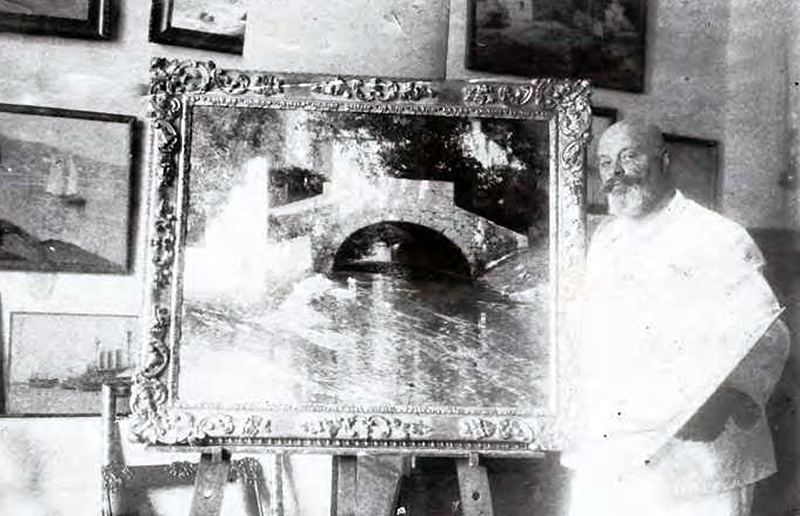
(Exhibit #4)
Varvara was eventually forced to leave the property.
Other traces disappeared more quietly. Irina recalls that after the birth of her mother, Olimpiada, named after her grandmother, Alexei Hanzen painted a little “portrait” of the baby directly onto a wall of Villa Olympia. Subsequent renovations erased it forever.
How many other works disappeared, were confiscated or destroyed? How many survive today unidentified in private collections? We simply do not know.
Hanzen's artistic legacy has already suffered enough from the political upheavals and displacements of the twentieth century, which makes what happened to this particular painting on the modern art market all the more irritating.
Remember where this story began: a signed painting by Alexei Vasilievich Hanzen, depicting the artist's own home, his own terrace and his own family, a work potentially connected to one of the most painful episodes in that family's history.
And how was it presented to the market? “Unframed coastal scene, signed lower right.”
Bravo.
The signature was there, but apparently nobody considered identifying it particularly urgent. The location was there, but nobody identified it. The family was there, but nobody knew it. The history was there, but nobody bothered to look for it.
And when DOCANTIC later contacted the auction house with the most basic provenance question, Where did this painting come from?, we were simply ignored.
At some point, inadequate research stops being amusing. Because there is another person in this story whom we must not forget:
the seller.
We do not know who consigned the painting. Perhaps it belonged to a collector, came from an estate, or was inherited by descendants who knew nothing about its signature or history. And that is precisely the point: they entrusted it to an auction house.
A consignor does not employ an auction house merely to photograph an object, assign it a lot number, sell it and collect a commission. The auction house is supposed to bring professional knowledge to the transaction: to look, research, catalogue and, when necessary, recognize that additional expertise is required.
Because when an auction house fails to identify an artwork properly, the potential loser is not the clever buyer who spots what everyone else missed. The potential loser is the seller who trusted the auction house to do its job.
We cannot, and will not, speculate about what this painting might have achieved at auction had its history been properly researched. But the difference in presentation is undeniable. What was offered as “coastal view, signed lower right” can now be presented as a signed work by Alexei Hanzen, grandson of Aivazovsky, depicting Villa Olympia and members of the artist's own family, with an extraordinary historical interpretation proposed by the artist's great-granddaughter and supported by previously unpublished family photographs and correspondence.
Would that information have mattered to collectors, attracted specialists, or perhaps brought the painting to the attention of an important collection or institution? We will leave that question to the market.
But pretending that all this information would have made no difference would be absurd.
But there is someone even more fundamental in this story whom we have not yet mentioned: the artist himself.
Without the artist, there is no painting. Without the painting, there is no seller, no buyer, no auction house, no hammer price, and no commission. The artist is not simply another participant in the art market. He is the reason the market exists in the first place.
An auction house handling an artwork is therefore not merely moving merchandise from one owner to another. For a brief moment, it is entrusted with a fragment of an artist's legacy. Identifying it, documenting it and preserving whatever history can still be recovered should be part of that responsibility, particularly for an artist like Hanzen, whose oeuvre has already suffered from revolution, exile, confiscation, dispersion and loss.
When that responsibility disappears, we no longer consider such a business representative of what the art market should be.
That is a consignment business. At worst, this auction house is a pawn shop with an auctioneer's hammer.
There is nothing wrong with running a consignment store or a pawn shop. But let's call things what they are.
The art market begins with art, and art begins with the artist.
Respect the Artwork... Respect the Artist. Period.
Unfortunately, this is not an isolated problem. Too much of today's art market has become an industrial process:
Receive. Photograph. Measure. Upload. Sell. Collect the commission. Next lot.
Auction houses may argue that they process hundreds or thousands of objects and cannot undertake extensive research into everything. We understand the economics. We simply don't accept them as an excuse for abandoning professional curiosity.
Nobody expects months of academic research on every object. But when a painting is signed, perhaps reading the signature is not an unreasonable place to start. And when an auction house lacks the expertise to pursue an attribution, there are scholars, archives, specialists and independent experts who can.
Because the alternative is exactly what happened here: an artwork can pass through the market carrying its history silently inside it, and once it disappears into another private collection, that history may remain buried for decades.
Or forever.
This painting had one enormous piece of good fortune: it found the right buyer.
The buyer had enough taste and curiosity not to assume that an auction-house label represented the final word. He looked at the painting, looked at the signature and eventually contacted DOCANTIC.
Had he simply hung his pleasant little “coastal view” on a wall, its story might have remained undiscovered for another ten, twenty or fifty years. Perhaps nobody would ever have contacted Irina, the terrace would never have been recognized, and Varvara and Misha would have remained tiny anonymous figures in an unidentified landscape.
The painting survived revolution, exile, war, the dispersion of Hanzen's work and almost a century separated from its history.
It would have been rather unfortunate for all of that to be finally defeated by lazy cataloguing.
Art history is full of dramatic destruction. Wars destroy artworks, revolutions disperse collections, governments confiscate property, buildings are demolished, paintings burn and archives disappear.
But history can also be lost in a much quieter way: nobody bothers to look. An artist's name becomes “unknown,” a signature becomes “indistinct,” a family becomes “figures,” and a home becomes “coastal view.” Eventually, everybody forgets there was ever anything more to discover.
That is not scholarship, and it should not become an acceptable standard simply because the object successfully sells.
For Irina Kasatskaya, the rediscovery of the painting was deeply moving. Seeing it immediately evoked memories of her family, while examining its tiny figures brought back stories transmitted across generations about Alexei, Olimpiada, Varvara, Misha, Konstantin and a family separated after the Russian Revolution.
Her generosity transformed our investigation. She shared historical photographs from her family archive, identified Villa Olympia and its terrace, and examined the figures with her daughter. Most importantly, she gave those tiny figures their human context.
There is something extraordinary about the correspondence between photograph and painting. A private black-and-white photograph preserved within the family for generations suddenly seems to come alive in color through Hanzen's canvas: the terrace, the landscape, Varvara and Misha, and perhaps the absent husband and father for whom they were waiting.
A photograph preserved for nearly a century and a painting separated from its history for decades had finally met again. And with that meeting, something more important than an attribution or a price was restored: a family was brought back into the picture.
DOCANTIC wishes to express its profound gratitude to Irina Kasatskaya for her generosity, her extraordinary knowledge of her family's history and her invaluable assistance in the authentication, identification and documentation of this painting, including the family photographs from her private archive reproduced throughout this article.
Irina Kasatskaya is a historian and researcher who has devoted extensive work to documenting the life, oeuvre and family history of Alexei Hanzen. Collectors, historians and researchers wishing to learn more about the artist and her publications are warmly encouraged to visit Hanzen Gallery.
The art industry is not only about buying and selling, Or at least, it should not be. It is also about preserving knowledge: questioning a label, following a signature, opening an archive, comparing a photograph and listening when a great-granddaughter suddenly recognizes the terrace on which her family once walked.
Every dealer, auctioneer, expert, collector or historian who handles an artwork becomes, temporarily, a custodian of its history. We are custodians before we are merchants. And sometimes expertise means more than determining who painted something: it means giving an artist back his name, a landscape back its location, anonymous figures back their identities and a family back its story.
This painting entered the market as “Unframed coastal scene, signed lower right.” It emerged from our investigation as a painting by Alexei Vasilievich Hanzen, depicting his own home at Villa Olympia, Varvara and Misha, and perhaps, according to the deeply moving interpretation of his great-granddaughter, the absent Konstantin finally reunited with his wife and son in the only place Hanzen could make that reunion possible: on canvas.
The real reunion never happened. The painted one survived. Almost a century later, it found a collector curious enough to ask questions, found the artist's great-granddaughter, and finally recovered its history.
This is what DOCANTIC is for: not simply to tell you what an artwork might be worth, but to discover what it is, and to put artists, artworks and sometimes the people inside them back into history.
Putting a price on a painting can take a few minutes.
Bringing it back to life takes a little more work.
The case is no longer anonymous
Following our investigation, the identification of the location, comparison with historical photographs, research into the Hanzen family archives and, above all, the invaluable assistance of the artist's great-granddaughter, Irina Kasatskaya, DOCANTIC can now affirm that this painting is an oil on canvas by:
Alexei Vasilievich Hanzen (1876–1937) - also: Alexey Vasilyevich Hanzen - and in Cyrillic: Алексей Васильевич Ганзен
View of Gruz Bay from Villa Olympia in Dubrovnik, circa 1926–1929
A century later, the painting has finally recovered its identity.
DOCANTIC LOCUTA, CAUSA FINITA
IN MARMORE INCIDATUR
Case closed
